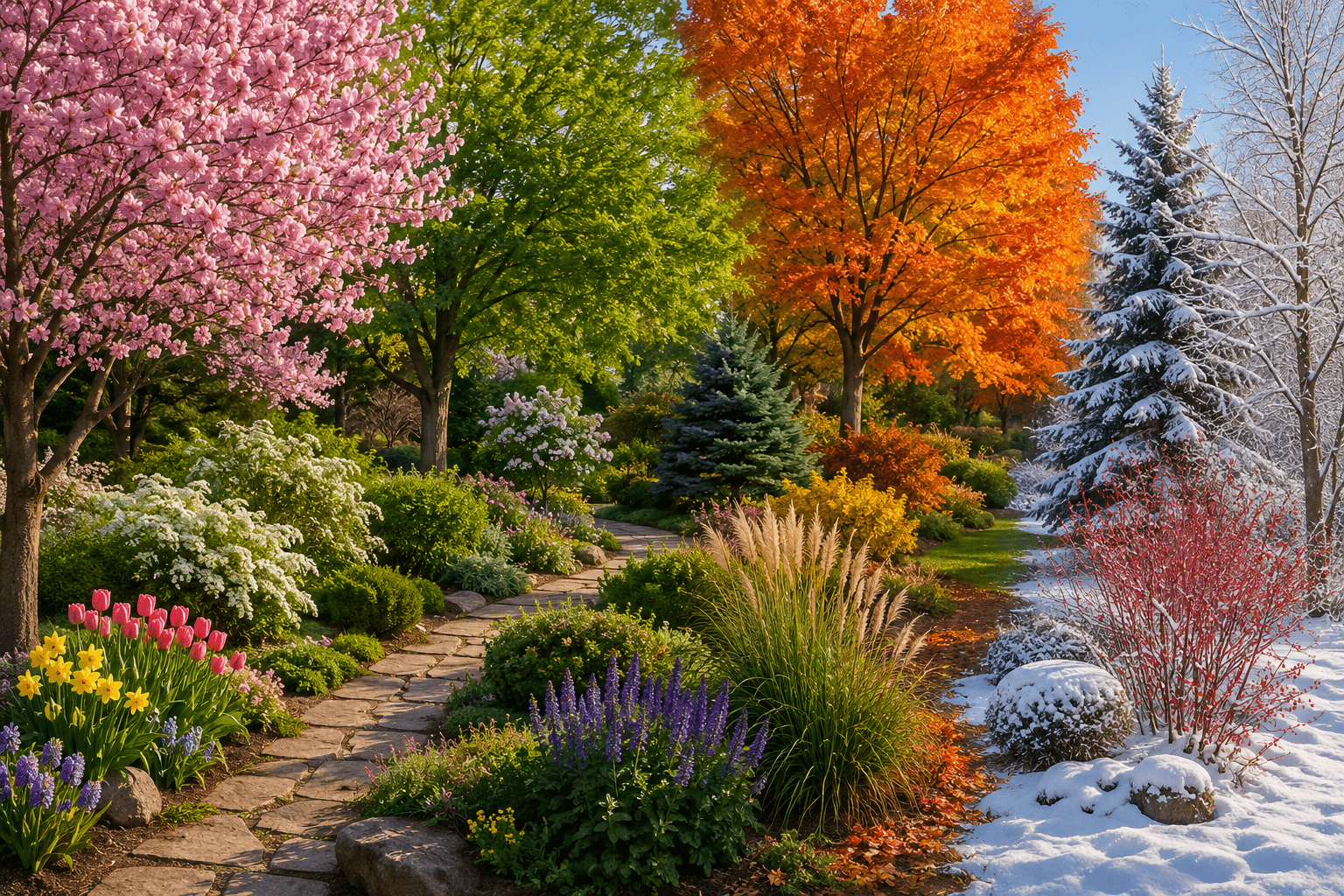
A stunning landscape isn’t created by what blooms in May alone. The most memorable gardens offer something beautiful every month of the year. Whether it’s colorful spring flowers, lush summer foliage, fiery autumn leaves, or elegant winter textures, a thoughtfully designed landscape evolves with the seasons rather than disappearing when the flowers fade.
Many homeowners make the mistake of shopping for plants during spring when garden centers are overflowing with blooming perennials and flowering shrubs. While those plants certainly deserve a place in the landscape, relying solely on spring color often leads to gardens that feel empty for the remaining nine months of the year.
Professional landscape designers approach planting differently. Instead of asking, “What looks good today?” they ask, “What will this garden look like in January? In July? In October?” Every plant is selected because it contributes something unique throughout the year.
The secret to creating an exceptional landscape isn’t buying more plants—it’s choosing the right plants that provide year-round interest.
In this guide, you’ll learn how to select trees, shrubs, perennials, ornamental grasses, and evergreens that keep your yard attractive during every season.
Why Four-Season Landscaping Matters
A landscape should never have an “off season.”
When one plant finishes blooming, another should begin. When flowers fade, colorful foliage should take center stage. When leaves drop, bark texture, berries, and evergreen structure should carry the landscape through winter.
Designing for all four seasons offers several benefits:
- Better curb appeal year-round
- Increased property value
- Less temptation to constantly replace plants
- More enjoyable outdoor spaces
- Continuous habitat for birds and pollinators
- Lower long-term maintenance
Instead of relying on flowers alone, successful landscapes combine several visual elements.
Think Beyond Flowers
Flowers are only one piece of the puzzle.
Professional designers consider:
- Leaf color
- Leaf texture
- Plant shape
- Bark texture
- Branch structure
- Seed heads
- Fruit and berries
- Evergreen foliage
- Fall color
- Winter silhouette
A plant that never blooms can still become one of the most beautiful features in your landscape.
Start With Structure
The “bones” of the landscape should look attractive every day of the year.
Think of these as your permanent framework.
Examples include:
- Evergreen trees
- Evergreen shrubs
- Small ornamental trees
- Decorative grasses
- Large shrubs
- Stone features
- Garden walls
- Pathways
Once the structure is in place, seasonal flowers become accents rather than the entire design.
Choose Evergreen Plants First
Evergreens provide consistency.
Even after every deciduous tree loses its leaves, evergreens continue adding color and texture.
Popular evergreen choices include:
Boxwood
- Formal appearance
- Easy to shape
- Excellent foundation shrub
- Works in nearly every landscape style
Arborvitae
Perfect for:
- Privacy
- Vertical accents
- Windbreaks
Blue Spruce
Offers:
- Unique blue needles
- Strong architectural shape
- Winter beauty
Dwarf Alberta Spruce
Ideal near:
- Entryways
- Walkways
- Containers
Juniper
Provides:
- Low maintenance
- Various colors
- Groundcover options
- Excellent winter interest
Evergreens should make up roughly 25–35% of your planting design.
Select Trees for Multiple Seasons
A tree should offer more than shade.
The best landscape trees provide beauty during several seasons.
Look for trees with:
- Spring flowers
- Summer shade
- Autumn foliage
- Interesting bark
- Winter branching
Excellent examples include:
Serviceberry
Spring:
White blossoms
Summer:
Edible berries
Fall:
Orange-red foliage
Winter:
Graceful branching
River Birch
Known for:
- Peeling bark
- Attractive trunk
- Fast growth
- Four-season interest
Japanese Maple
Offers:
- Elegant form
- Beautiful foliage
- Fall color
- Sculptural winter appearance
Red Maple
Famous for:
- Brilliant autumn leaves
- Strong shade
- Attractive branching
Dogwood
Provides:
- Spring flowers
- Summer foliage
- Red berries
- Winter branch structure
One tree can become the focal point of an entire landscape.
Mix Bloom Times
One of the easiest ways to extend beauty is staggering bloom periods.
Instead of planting ten shrubs that bloom in May, select plants that bloom across the growing season.
Example:
Early Spring
- Crocus
- Daffodils
- Tulips
- Hellebores
Late Spring
- Lilacs
- Peonies
- Rhododendrons
Early Summer
- Coneflowers
- Salvia
- Daylilies
Mid Summer
- Black-eyed Susans
- Lavender
- Bee Balm
Late Summer
- Sedum
- Russian Sage
- Hydrangeas
Fall
- Asters
- Chrysanthemums
- Anemones
Your garden always has something happening.
Choose Plants With Colorful Foliage
Flowers eventually disappear.
Leaves often last six months or longer.
Beautiful foliage plants include:
- Coral Bells
- Japanese Forest Grass
- Hostas
- Coleus
- Smoke Bush
- Ninebark
- Purple Barberry
Combining green, burgundy, silver, chartreuse, blue, and variegated foliage creates interest even when nothing is blooming.
Include Ornamental Grasses
Many homeowners overlook grasses.
Landscape designers rarely do.
Ornamental grasses add:
- Movement
- Texture
- Sound
- Winter interest
- Wildlife habitat
Excellent choices include:
Karl Foerster Feather Reed Grass
Stands upright through winter.
Switchgrass
Provides:
- Summer greenery
- Fall color
- Winter texture
Little Bluestem
Known for:
- Blue summer foliage
- Copper fall color
- Winter beauty
Fountain Grass
Creates soft movement throughout the season.
Leave grasses standing until early spring for maximum impact.
Plant Shrubs That Offer More Than Flowers
Many flowering shrubs only bloom for a few weeks. Instead, choose shrubs that provide multiple benefits. But before selecting shrubs for your property line, learn how to create effective landscape boundaries.
Examples include:
Hydrangeas
Offer:
- Long bloom season
- Dried flowers
- Winter interest
Ninebark
Provides:
- Colorful foliage
- Peeling bark
- White spring flowers
Red Twig Dogwood
Beautiful because of:
- Bright red winter stems
- Summer foliage
- White flowers
Viburnum
Features:
- Spring blooms
- Berries
- Fall foliage
- Wildlife value
Think About Fall Color
Autumn is one of the most beautiful seasons.
Design for it intentionally.
Outstanding fall performers include:
Trees:
- Sugar Maple
- Red Maple
- Ginkgo
- Sweetgum
Shrubs:
- Burning Bush
- Fothergilla
- Oakleaf Hydrangea
- Sumac
Perennials:
- Sedum
- Asters
- Chrysanthemums
A landscape rich in fall color extends enjoyment long after summer ends.
Don’t Forget Winter Beauty
Winter landscapes don’t have to look empty.
Some plants become even more attractive after snowfall.
Winter stars include:
- Red Twig Dogwood
- River Birch
- Paperbark Maple
- Holly
- Evergreen Magnolia
- Boxwood
- Arborvitae
- Winterberry Holly
- Ornamental grasses
Snow highlights texture, bark, and structure.
Add Plants That Produce Berries
Berries provide:
- Winter color
- Food for birds
- Seasonal contrast
Great choices include:
- Winterberry Holly
- Serviceberry
- Viburnum
- Beautyberry
- Crabapple
- Cotoneaster
These plants continue looking attractive after flowers fade.
Layer Plants for Visual Depth
Professional landscapes rarely place plants in a single row.
Instead, they use layers.
Example:
Back layer:
Large trees
Middle layer:
Shrubs
Front layer:
Perennials
Edge:
Groundcovers
This creates depth and makes every season feel fuller.
Consider Texture
Texture creates visual interest even when colors are subtle.
Mix:
Fine textures:
- Grasses
- Lavender
- Ferns
Medium textures:
- Coneflowers
- Hostas
- Hydrangeas
Coarse textures:
- Elephant Ear
- Large Hostas
- Ligularia
Texture keeps gardens interesting from every angle.
Repeat Plants Throughout the Landscape
Avoid planting one of everything.
Instead, repeat the same plants throughout the yard.
Repetition creates:
- Unity
- Rhythm
- Balance
- Professional appearance
A repeating palette always feels more intentional than a collection of random plants.
Choose Native Plants Whenever Possible
Native plants often:
- Live longer
- Require less water
- Need less fertilizer
- Resist local pests
- Support pollinators
- Thrive naturally
Research plants native to your region before shopping.
They usually outperform exotic species in long-term landscapes.
Pay Attention to Mature Size
One of the biggest landscaping mistakes is planting without considering mature growth.
Always read the plant tag.
Know:
- Mature height
- Mature width
- Sun requirements
- Soil preferences
- Water needs
Plants crowded together eventually require expensive pruning or removal.
Proper spacing saves money.
Plan for Sun and Shade
Plants thrive when placed in the right environment.
Sunny areas typically suit:
- Lavender
- Coneflowers
- Daylilies
- Russian Sage
- Ornamental grasses
Shady areas often favor:
- Hostas
- Astilbe
- Ferns
- Heuchera
- Japanese Forest Grass
Matching plants to their ideal conditions reduces maintenance and improves performance.
Use Containers for Seasonal Flexibility
Permanent plantings can be enhanced with seasonal containers.
Spring:
- Tulips
- Pansies
- Daffodils
Summer:
- Petunias
- Geraniums
- Calibrachoa
Fall:
- Ornamental kale
- Mums
- Pumpkins
Winter:
- Evergreen boughs
- Birch branches
- Pinecones
- Red berries
Containers let you refresh your landscape without changing the permanent design.
Support Wildlife Year-Round
A beautiful landscape is also a living ecosystem.
Choose plants that provide:
- Nectar for pollinators
- Seeds for songbirds
- Shelter for wildlife
- Berries during winter
Good wildlife plants include:
- Coneflowers
- Milkweed
- Serviceberry
- Viburnum
- Winterberry Holly
- Little Bluestem
- Oak trees
The result is a garden that’s full of life in every season.
Create a Seasonal Checklist
As you plan your landscape, ask yourself these questions:
Spring
- What blooms first?
- Are bulbs emerging?
- Do flowering trees provide color?
Summer
- Which plants bloom longest?
- Is there enough foliage contrast?
- Are pollinators attracted to the garden?
Fall
- Which plants develop brilliant foliage?
- Are late-season flowers blooming?
- Do grasses and seed heads add texture?
Winter
- Are evergreens providing structure?
- Is colorful bark visible?
- Are berries available for birds?
- Do ornamental grasses remain standing?
If every season has multiple “yes” answers, you’re on the right track.
Common Mistakes to Avoid
Even experienced gardeners can make choices that leave a landscape looking dull for much of the year. Avoid these common pitfalls:
- Buying only what is blooming at the garden center.
- Planting too many varieties without a cohesive design.
- Ignoring mature plant size and spacing requirements.
- Relying entirely on annual flowers for color.
- Removing ornamental grasses and perennial seed heads in the fall instead of leaving them for winter interest.
- Forgetting to include evergreen shrubs and trees.
- Choosing plants based solely on appearance rather than their growing conditions.
- Overlooking bark, berries, and foliage as sources of seasonal beauty.
A well-planned landscape is built on balance, not impulse purchases.
Final Thoughts
Creating a landscape that looks beautiful throughout the year isn’t about having the biggest garden or the most expensive plants. It’s about making intentional choices that ensure every season contributes something unique to your outdoor space.
By combining evergreen structure, trees with multi-season appeal, colorful shrubs, long-blooming perennials, ornamental grasses, and plants with striking foliage, berries, or bark, you can create a landscape that remains inviting from the first spring blossoms to the quiet beauty of winter snow.
The most successful gardens tell a story that changes with the seasons. Spring brings fresh growth and vibrant blooms, summer delivers lush abundance, autumn paints the landscape with rich color, and winter reveals the elegant architecture of branches, bark, and evergreen foliage. Each season builds on the last, creating a landscape that never feels empty or forgotten.
When selecting new plants, resist the temptation to ask only, “How does it look today?” Instead, imagine how it will contribute in six months—or even six years. That shift in perspective is what separates an ordinary yard from a professionally designed landscape.
With thoughtful planning and a focus on year-round interest, your garden can become a place of beauty every day of the year, welcoming you home with color, texture, and character no matter what the calendar says.